Showing posts with label Barack Obama. Show all posts

Thursday, March 12, 2009

First Female President: Barack Obama


When reflecting on this course, I noted that we subconsciously defined gender to be about women.  This is very similar to the idea behind race, that is, a white person does not have to deal with race, just as men do not have to deal with gender.
Obviously, this makes little sense, as male is a sex just as much as female is.  
And yes, there is a distinct difference between sex and gender, but the concept still applies.
I therefore decided to look at the males in the election, and stumbled on this article in Newsweek.
The author first notes that this is not the first time that a president's values, actions, and persona have emulated a person in a different role or category.  He sites former president Bill Clinton as the "first black president" due to his penchant for playing the saxophone and his display of "almost every trope of blackness"
He goes on to say that Barack Obama seemed to be playing a traditional female role.
Obama doesn't play the sax. But he is pushing against conventional- and political party nominating convention-wisdom in five important ways, with approaches that are usually though of as qualities and values that women bring to organizational life: a commitment to inclusiveness in problem solving, deep optimism, modesty about knowing all the answers, the courage to deliver uncomfortable news, not taking all the work alone, and a willingness to air dry linen.
However, the campaign is over, and the authority with which Obama has taken office has shown that his not one to be trifled with.  Perhaps this has made him appear more masculine, but I believe that it is his willingness to accept these gender stereotypes as part of his own that he has been able to pass the stimulus bill and get a strongly divided congress to agree on so many other matters.
Perhaps America does need a female president, and for right now, his name is Barack Obama

Monday, February 23, 2009

Rationalizing the Democratic Primaries

  I did not decided who I was going to vote for in the democratic primary election until I got into the voting booth.  I researched both Hillary Rodham Clinton and Barack Obama thoroughly, comparing their stances on many issues, ranging from education to the environment, to the war on terror.  However, when I prioritized my views, it all came down to classic women's issue, such as abortion, equal pay for men and women, and gay marriage.
  Both Obama and Clinton both supported me views, and as I realized that all other issue paled in comparison to these, I felt both ashamed and confused.  I was ashamed because I knew that there were many other issues that these two candidates differed on that were very important for the whole country as well as the rest of the world and confused because I still had no idea which candidate I preferred.
I worked as a poll worker during the 2007 and 2008 elections, so I was very closely tied them, having experienced them from both sides.     Photo: http://www.pollingplaceproject.org/
While I was not present during the presidential election because I was here at school, I spoke to my mother about her experience late that November night.  She told me that when we opened our garage to allow voting to begin at seven, there was already a line forming down our street.  We were not alone as this was a trend all around the country.  
Being a poll worker has given me a new perspective on elections.  I remember during the primaries, watching people come into my garage to vote.  Some looked self-assured, others mirrored my own confusion, but everyone appeared to understand the implications of their decisions.  Knowing that there were others who had feelings that were just as confused and muddled as my own were gave me a feeling of unity.  Before then, I never felt, and for the most part, still do not feel that democracy is unifying, as I imagine it ought to be, but in that moment, I was proud to be an American.
Perhaps that was what stirred the memory that decided the election for me.  As I entered the voting booth, I was stuck by childhood dream.  As a child, I wanted to either be a veterinarian or the first woman president.  Deep in the throes of college applications, I knew I was already following one of those dreams and politics was not involved.  Perhaps it was the stigma of being able to see both of my dreams achieved, I took my "special" ballot marking pen and drew a line connecting the arrow next to Hillary Rodham Clinton's name and did not look back on my decision.  
I was not upset when Obama won the nomination and I eagerly voted for him in the November election from my dorm room, and was ecstatic when he won later that night. 
Looking back on it, I did not have a large preference between Obama and Clinton, and my decision came down to a childhood wish.  Would I be hypocritical and judge other people for making decisions for similar reasons? Yes.  Do I feel that this decision was rash? Probably.  Do I regret my decision? Not at all.

Sunday, February 22, 2009

The Election Is Over; Now It Is Time to Analyze It

Yes, the election is over, and Obama is already taking his first few footsteps in the White House, but we cannot leave this noteworthy election behind.  This past election was important to us in so many ways.  It marked the beginning of many opportunities for change.  It was the first time a serious woman candidate was in the running, and it was also the first time an African-American was running to be president of the United States of America.

As a very aware and intellectual society, it is our calling to analyze the results of this 2008 presidential election.  As a whole, as a country, we need to work together in trying to understand the twists and turns of this election-- who voted for whom, possible influences on voters' preferences for a candidate, etc.  Our class has been pondering this all quarter long now.  It is very hard to know exactly what caused specific events or situations to happen and how much of an effect certain influences did have.

Our class sent out an online survey that included questions about the reasons why voters voted for whoever they chose.  People's reasons varied immensely; however, it was interesting to see and note that some women voted for Clinton (in the primaries) just because she was a woman.  Interestingly enough, some African-Americans voted for Obama for the same reason-- just because he was an African-American.  They wanted to see "their kind" take foot in the White House.

The New York Times has posted a very interesting interactive graphic on "How Different Groups Voted in the 2008 Democratic Presidential Primaries."  You can click on the boxes underneath the graphic to see how different demographics of voters voted.  I examined "Women" and "Blacks."  When I clicked on the "Women" box, I noticed that there was a pretty even split-- about half the states had stronger Clinton support, and half had stronger Obama support; however, when I clicked on the "Blacks" box to see how African-American voters voted, all 28 states represented in the graphic were on the right-hand side.  They all had stronger Obama support.  This really sparked my interest.  Did African-Americans feel a greater need to support an African-American candidate than woman did to support a female candidate?

There are so many factors that probably influenced the election.  There was a range of different influences that could have affected voters' decisions-- from media to voters' perceptions.  There is no way to perfectly analyze the election results and the reasons why everyone voted the way they did, but we should look at all the results and hard proof that we do have to better understand this 2008 presidential election.

Thursday, February 19, 2009

My Flirt with Sarah Palin

A feeling of relief inundated my mind as the results of the November 4 presidential election were announced. No longer would I have to debate others over who I voted for in the presidential election. My decision was made and now the election season was finally over.

I am a Democrat. I have been since the presidential election that occurred when I was in second grade. I support a woman’s right to choose, the freedom to choose one’s life partner, the environment, and helping the poor. I was against the War in Iraq from the beginning. I supported former vice-president Gore for president in 2000 and United States senator John Kerry in 2004. In 2008, I wholeheartedly supported Hillary Clinton for president.

After Hillary conceded the Democratic nomination to Barack Obama, I became disappointed and even depressed. I could not recall a time when I had so fervently supported one candidate. To me, Hillary was a hero, an inspiring politician, and a champion. I decided to commit my support to Hillary in January 2008. When Hillary won a primary or a caucus, my spirits were lifted. When she lost a contest, I voiced frustration but also heightened support for her to remain in the race. Just like Hillary’s other supporters, I was angry at the media and the Democratic Party establishment. In my opinion, they were biased toward Barack Obama.

Once Hillary’s loss became a reality, I turned to Obama to see whether he would do all he could to raise money to retire Hillary’s campaign debt. I looked to see if Obama would choose Hillary to be his running-mate or someone who had supported her. Neither of these things happened.

John McCain chose Sarah Palin, a dark-horse candidate and little known governor of Alaska, to be his running-mate on Friday, August 29, 2008. During the days leading up to vice-presidential announcements, I suggested that Obama choose Evan Bayh and McCain choose Palin. To say I was surprised when I found out would be an understatement. I screamed and jumped all around my apartment. McCain did it! McCain did it! He actually chose Sarah Palin. (Never did I think McCain would take a gamble by selecting Sarah Palin!)

McCain made a political decision when he selected Sarah Palin. It was clear McCain was sending a signal to disgruntled Hillary supporters and disappointed women that a woman may still have an important role at the White House. I think McCain was playing the gender card and he was smart to do so. His campaign was struggling and dying. McCain desperately needed a game-changer.

Sarah Palin brought to the McCain campaign three things: a new image for the McCain campaign, expanded support among voting demographics, and a revitalization of a failing presidential campaign.

Palin, 44, brought her youth to McCain’s campaign, invoking a refreshing and new picture. The image of Palin’s family brought family issues such as teenage pregnancy and special needs children into the presidential debate. Palin’s conservative credentials shored up support among factions of the Republican Party. Her executive experience coupled with McCain legislative experience added to the presidential ticket.

I did not agree with Sarah Palin on a wide-range of issues including the right to an abortion and keeping ANWAR off limits. I did not agree with many statements Palin made. I thought her debate performance with Joe Biden was awful.

So why was I attracted to the McCain-Palin team? It’s simple, the McCain-Palin ticket reached out to me. While I realize McCain was just trying to earn votes, he appealed to me when he praised Clinton’s historic candidacy. He appealed to me when he chose Sarah Palin, a political newcomer and maverick.

Do I think the choice of Sarah Palin as vice-president was a smart and risky decision? You betcha!

Did Sarah Palin cause more damage to or reinvigorate support for McCain’s candidacy? That’s debatable.

It was a difficult choice when it was time for me to fill out a vote-by-mail ballot. As attractive as the selection of Palin was to the McCain campaign, I did not vote for McCain. I also did not vote for Obama. Who did I vote for? I voted for Hillary Clinton.

Tuesday, February 10, 2009

Why I Voted for Barack Obama

I'm a moderate republican. I like the 2nd amendment, the death penalty, and Ayn Rand. I'm a capitalist at heart and I believe the best societies have more financial freedom. I'm also a woman, and some of my social views are pretty liberal. Because of this I spent a long time debating who I should vote for, making lists of the candidates' platforms and voting records, and trying to align those with my own views. Even though there were only two choices, I felt like who I picked would tell me a lot about myself and which views I found more important. For a long time, I couldn't make the decision. The answer easily came to me in early September, and my decision never wavered after that.

I chose to vote for Barack Obama because of the introduction of Sarah Palin as the Republican Vice Presidential pick. When I initially heard rumors of McCain's choice, I thought two things. 1) He is using her gender to get the female vote, and to compete with the fact that the democrats had a historical nominee. 2) It could be nice to have a female as second in command for a change. The second thought disappeared as soon as I discovered Sarah Palin in no way represented the values that I do, as a female, and Barack Obama absolutely did.

When I heard Palin say things like, "I'd oppose abortion even if my own daughter was raped," my feelings about guns and the free market were no longer important. When I found out about her desire to push an abstinence-only sex education on the nation's youth, it was like I had not even read The Fountainhead. Sarah Palin opposed expanding hate crimes to include sexual orientation (I believe homosexuality is included in women's issues), and advocated making women buy their own rape kits, and just in general, seemed to oppose everything women activists have fought for for the past century.

2008 was my first presidential election, and it was certainly very interesting. What I took from it, more than anything, was that the economy will rise and fall as it normally does. I am always open to my political views changing, as they have in the past. I was not born a republican, but a woman, and I will die a woman, so I am a woman first, and my rights need to be protected. My right to govern my own body, my right to marry who I want, my right to not have to take out a loan to find out who raped me, my right to the knowledge about safe sex - all of these made Obama the right choice for a female who finds these issues important. Most of all I learned that the gender of an individual doesn't make them a feminist, their actions and choices do. If Sarah Palin had become the Vice President of the United States, I believe feminism would have lost a lot of hard-earned progress, and that is why I voted for Barack Obama.

Monday, January 26, 2009

Obama's Plan to Revolutionize Politics


As we all know, Obama has proven to the world that fully utilizing the internet as a campaign tool can yield incredible, successful results. But how will he continue to engage the American public now that he has taken over as president? A New York Times article called "Melding Obama's Web to a YouTube Presidency" provided a description of how the White House plans to implement its goals using the numerous mechanisms the internet has to offer. 

Obama, a former community organizer, has made it clear from the beginning that turning his campaign's unprecedented usage of immensely popular new media into a functional government tool is one of his most important ambitions for the administration. By involving the public with its government through social networking websites and directly reaching Americans with YouTube videos, Obama hopes to break through the middle-man media and connect with citizens more directly and efficiently. 

However, legal barriers apply; the White House is unable to use the 13-million-person email list compiled during the Obama campaign due to the fact that it was created for political purposes, so instead the huge undertaking of updating American politics to a nation of YouTube and Facebook users has been delegated to the Democratic Party. The group in charge of assembling Obama's upcoming machine of video messages, blogs detailing administration policy, and other political resources is still fundraising and has not fully developed a website but has ambitious plans for implementation. 

While it's certainly important to keep up with the mainstream technology and news-gathering habits of America, it is also necessary to consider those who are being left out of Obama's project. The internet is expansive, but it's also not readily available to all American citizens, particularly those who don't own computers. Older generations who have computers but don't necessarily go online on a regular basis are also not being included in this internet-based political system.

Moreover, communicating information directly from the White House to the public eliminates the media as a moderator. If citizens rely unquestioningly on this discourse alone, they miss out on the press's criticisms and may interpret the administration's characterizations of events and policies as the absolute truth. 

So far, Obama's moves to convert the country to a pop media-based age of information have been incredibly effective (after all, he got elected). I was interested to see if this issue might be somewhat gendered, so I found another article printed by the New York Times almost a year ago regarding Hillary Clinton's contrasting political strategies. Entitled "The Audacity of Hopelessness," this article chastises her tendency to "[keep] to the Bush playbook," playing it old school throughout her campaign and failing to engage the public the way Obama did. The article reads:
Clinton fans don't see their standard-bearer's troubles this way. In their view, their highly substantive candidate was unfairly undone by a lightweight showboat who got a free ride from an often misogynist press and from naive young people who lap up messianic language as if it were Jim Jones's Kool Aid.
Once again, the media blames Hillary Clinton for playing the gender card. While Clinton certainly didn't employ innovative campaign tactics like her rival Obama, it seems unfair to blame her failure on whining about sexism. In this way, it seems that candidates' strategies for promoting themselves is at least somewhat tied up in gender. 

President Obama's plan to change popular politics and engage citizens to influence policy and increase their civic participation is certainly ambitious, but judging from the way he revolutionized the 2008 election, the administration's goals seems entirely possible. One just has to wonder if such formidable goals could have been accomplished by a woman with her own political strategy. 


Sunday, January 25, 2009

Obama's Desire for More Women in Science

I found an interesting article in the New York Times on how Obama plans to address issues of women in science.  It is not that women are not capable of researching such math-heavy and logic-oriented concepts.  Likewise, it is not that women do not not have the drive and stamina to keep up with the work of such time-consuming jobs. Rather, it is actually for a science-related reason that most women choose not to go into such demanding careers within the field of science.  Women are the child-bearers of our country.  Women are needed to have families and produce children that can continue our nation, our ways of living, etc.  This hugely time-dependent reason might be what is holding women back from pursuing careers in science.  Obama wants to try to fix this.  In the article, "In 'Geek Chic' and Obama, New Hope for Lifting Women in Science," Natalie Angier writes:
Dr. Mason and other legal experts suggest that President Obama might be able to change things significantly for young women in science-- and young men-- by signing an executive order that would provide added family leave and parental benefits to the recipients of federal grants, a huge pool of people that includes many research scientists.
This would probably cause there to be less of a gap between genders when it comes to math and science and research.  It is nice to know that Obama is looking out for women wanting to reach their full potentials, career-wise and all.

More than Just the First African-American President

New York Times writer Jodi Kantor's article, "Nation's Many Faces in Extended First Family," highlights all of the diversity and history that is being brought to the White House through our new president.  Not only does Obama bring the title of "first African-American president" to the capital, but he also brings a detailed and very diverse past with him.  Kantor writes:
The family that produced Barack and Michelle Obama is black and white and Asian, Christian, Muslim and Jewish.  They speak English; Indonesian; French; Cantonese; German; Hebrew; African languages including Swahili, Luo and Igbo; and even a few phrases of Gullah, the Creole dialect of the South Carolina Lowcountry.  Very few are wealthy, and some- like Sarah Obama, the stepgrandmother who only recently got electricity and running water in her metal-roofed shack-- are quite poor.
I think this extreme diversity that Obama encompasses will be an asset to the White House and to his role as president.  Having grown up with a family born into slavery, limited resources, and no fame to his name (has no predecessor like the former president, George W. Bush, had), Obama had to make a name for himself.  In order to propel himself this far, he had to have some serious dedication to his education and to reaching his potential.  Obama's self-determination for success can probably only be a benefit to our nation.

Thursday, January 22, 2009

Ten Principles Paralleled

Being a daughter, Obama’s letter to his daughters Sasha and Malia struck a chord with me. In 'What I Want for You — and Every Child in America, ' Obama draws upon a variety of guiding principles of effective leadership to express his vision in the cause for “Change.” It might surprise some that the same ten principles used to build leaders in the West Point military academy are being used by Obama to communicate with his daughters and the public: duty, honor, faith, courage, perseverance, confidence, approachability, adaptability, compassion and vision. The letter as touching and genuine as it may be obviously has a deeper political purpose. I see an interesting parallel between military leadership techniques and Obama’s persuasive strategy.


One aspect of effective leadership is to have vision. Obama’s letter to his daughter represents dual purposes. It is in part an expression his appreciation and vision for the future for his daughters as well as a vision and goals for the children of all people. It serves as a road map and call for action and change. He highlights his vision for education, and touches on health care, and jobs, then moves to the environment and wars as factors that affect families.


He opens with a humorous reference to eating junk food, which reminds us of our duty to ourselves to eat right. It connects on an emotional and rational level. He creates a sense of community and sort of social moral contract. Duty is another key guiding principle for effective leadership. He tells both his daughters and the public of a duty to hitch your wagon to something larger than yourself and make this imperfect nation more perfect. He eloquently weaves a connection to faith, honor and duty saying, “The blessings these men and women fight for are not free.” He also refers to religion and the need for broader perspectives later mentioning the connection between religious differences and division in community which sometimes keeps us from seeing the best in each other. We are left with the tone of contrasting seriousness in connection to everyone’s duty on the national level.


His message applies principle of honor too. Honor involves creating a sense of community. He gives recognition and approval, especially in the closing, saying he is proud and grateful for his daughters “patience, poise, grace and humor.”


He further creates an intense sense of awareness of the importance of community, and particularly families, when he mentions that all his big plans for himself didn’t seem so important after his children were born. He wanted both his daughters and every child in the nation to have opportunities for happiness and fulfillment. He conveys a sense of the importance of the principle of perseverance by referring to his personal life quest which began as a young man, thinking “it’s all about me” and then referring to the larger lesson learned from his grandmother involving the need to persevere to attain the principle of equality for all men.


In many ways he includes the principle of compassion. He expresses empathy on a personal level recognizing how the campaign was not easy for his daughter’s Malia and Sasha and their mother and his compassion on a political level, for those who have not been granted the full rights of equality as spelled out in the declaration of independence.


The way he leverages important social issues from the campaign: education, the environment and war, saying he wants his daughters and other children to see the discovery of new technology and inventions that make the world cleaner and safer, was effective selling of his ideas. In doing so, it becomes a call for action from educators, scientists, environmentalists and the military to join in his vision. He even alludes to collegiality among women using terms like “committed women” near the end of his letter.

The Effects of Gender and Race in Politics: What Effects?

From observing politics for the past few years, I came to the conclusion that there are no dramatic effects of gender or race unless a politician provokes such effects. Now, I do know that voters do tend to choose candidates according to who they can relate more towards, but I don’t think that such impact is so profound that it’ll change votes single handily.

During the 2008 presidential election, I was surprised that gender had a much bigger impact on the election than I had initially thought. According to the New York Daily Times on May 2008, one of the six reasons Hillary wanted to be president was because of the “women in their 90s who had told her they were born before women could vote, and they wanted to live to see a woman in the White House”. When Hillary lost the Democratic nomination, McCain saw the opportunity to win over disgruntled Hillary supporters due to the emphasis that Hillary put on feminism in addition to Hillary’s slow and cautious backing of Obama. Surprising the world, McCain picked Palin to be his VP, an action which he would later regret. Palin made her central campaign theme focused on how she was just like any ordinary “hockey mom”. She fortified her campaign theme with subtle parts in her speeches such as calling herself a “Pitbull with lipstick” in addition to twisting her role as mom to be a qualification for being a VP. For example, during the VP debate, Palin continuously described her role as a mom when she stated:

But it wasn't just that experience tapped into, it was my connection to the heartland of America. Being a mom, one very concerned about a son in the war, about a special needs child, about kids heading off to college, how are we going to pay those tuition bills?

The full VP debate transcript can be found here.

Unfortunately for Palin, her choice of using the theme of being a mom also had a disadvantage. Because Palin thought that being a mom was something worthy of being in the spotlight, the media naturally also focused on her theme of being a mom. So in today’s society, what does the normal “hockey moms” do? They take care of their kids, do daily household chores, and go to PTA events. All of which were topics that the media focused on. Many complained such treatment was sexist, but then again it was Palin’s own choice. She could have ran on her executive experience as governor, but instead she chose to run on being the first women to the white house.

I have also come to notice that just like gender, race doesn’t affect politics unless the politician makes race a key factor. For example, when Governor Blagojevich controversially appointed Burris to take Obama’s seat, many senators (including the democrats) initially objected to his appointment and wanted to block him from the senate. However, Senator Burris defended his appointment with a variety of reasons. One of the reasons, according to his good friend Representative Bobby Rush of Illinois, was because Burris is black! During the last few minutes of the press conference Gov. Blagojevich held regarding Burris’ appointment, Rep. Rush stated:

Let me just remind you that there presently is no African- American in the U.S. Senate. Let me remind you that the state of Illinois and the people in the state of Illinois and their collective wisdom, have sent two African-Americans to the U.S. Senate. That makes a difference. This is just not a state of Illinois matter, although it’s (INAUDIBLE) to appoint and (INAUDIBLE) — which is in the state of Illinois, but it (INAUDIBLE) — it has tremendous national importance — national importance. We need to have not just one African-American in the U.S. Senate. We need to have many African-Americans in the U.S. Senate.

So I applaud the governor for his decision. And I will ask you to not hang and lynch the appointee as you try to castigate the appointer. Separate, if you will, the appointee from the appointed. Ronald Burris is worthy. He is the only one, I believe, that could stand in the gap (INAUDIBLE) time, and gather the confidence — reestablish the confidence of the people of the state of Illinois.

(…….)

This is a matter of national importance. There are no African- Americans in the Senate, and I don’t think that anyone — any U.S. senator, who’s sitting in the Senate, right now, wants to go on record to deny one African-American for being seated in the U.S. Senate. I don’t think they want to go on record doing that. And so, I intend to take that argument to the Congressional Black Caucus.

The full transcript of the press conference is here.

Currently, there is heavy speculation that because Burris played the race card, many senators were afraid to block Burris’ appointment since the senators were afraid that they would be labeled as racist. Burris’ strategic usage of race heavily differed from Obama’s position with using race in his campaign. Surprisingly, Obama never mentioned race and gender in his campaign despite being the first African American presidential nominee. Even when issues about Obama’s race were brought up by his opponents, he brushed off the accusation and focused on the main issues campaign issues. Obama’s decision to never use race or gender in his campaign just shows how a politician is able to control whether or not race or gender will be an issue.

Wednesday, January 21, 2009

Let Freedom Ring


Let it be told: there is a time when truth needs to be faced.
Lately, in these dismal years, faces of our very own Americans, once representative of extreme pride, have glowed a sentiment of uneasiness. We were once the great nation that stood by our democratic ideals, and even amidst the horrors constantly brought to developing countries around us, our country still stood strong and proud. This has changed. Our sense of pride as a nation has diminished. Whether it be because the nation transformed into something other than a "peoples' nation" or because we simply needed a different plan of action, it became evident that change was necessary.

To keep America shining from sea to sea and regain that glow of pride, we have realized that we need to take charge and address the problems we are facing. As a country, we are making this happen one step at a time. It is just the beginning of a new era; however, it is the beginning of a new era for hope, a new era for change, and a new era for freedom, peace, and enlightenment. Like Martin Luther King Jr.'s sister, Christine King Farris, said to the Chicago Tribune in reference to what Martin Luther King, Jr. might say of this turning point, "He would say that we have reached a great milestone but we still have other milestones to reach. But this is a great beginning."

As President Barack Obama took oath on this 20th day of January 2009, our nation came together to recognize the importance of this drastic change and need for action. President Barack Obama delivered his Inauguration speech with such solemnity. He clearly presented all the problems that we, as a country, need to address, and he did so with such an uplifting tone and manner. His reoccurring theme of hope throughout the speech truly inspired Americans and gave our country the trust that we need to instill in a leader who is willing to take on such a challenge.

Like Franklin D. Roosevelt, it is evident that Barack Obama cares about his country. Both he and Michelle, First Lady, want to show their deep connect with the people of the United States of America. Barack has said that he wants to make use of new technology, such as YouTube, and Rachel Swarns, a writer for the New York Times, published that Michelle dreams of picnics with local citizens and their children.

Also, the way Obama delivered his speech reminded me of how a religious official or clergyman might deliver a sermon. He was very direct in his words to the people, and he continually referred to "we" (as a nation) making the changes, as opposed to just him. He emphasized that this will be a "team effort," like a congregation in a church or temple, and we will all be working together to "be the change [we] wish to see in the world" (Gandhi).

Let us welcome this great face of change into the White House: the face of Barack and the face of the Obamas as a family. In fact, Michelle will also bring some change to the White House. Rachel Swarns wrote in the New York Times:
On Inauguration Day, Michelle Obama will become the first African-American to assume the role of first lady, a woman with the power to influence the nation's sense of identity, its fashion trends, its charitable causes and its perceptions of black women and their families.
So, even though we might not have a woman in the White House as our 44th president, we have an African American, and this is truly an incredible feat for the United States of America. My country, tis of thee, please do the favor of recognizing the gravity of all these feats, and let freedom ring.

Monday, January 19, 2009

Letters From My Father

While watching CNN the other morning, I noticed an interesting piece on an internationally published letter from President Barack Obama to his two daughters Sasha and Malia. The entire letter, published on January 14th in Parade magazine, can be found here on the publication's website. In short, Obama expresses his belief in the advantages and responsibilities associated with being an American, outlining his reasons for "[taking] our family on this journey" and proclaiming his deep love and appreciation for both of his children. 

The message is sincere and heartwarming, but I have to question the necessity of publicizing these sentimental affects in one of America's most widely read newspapers. Clearly Obama's letter is addressed more directly to the American people as a whole than simply to 7-year-old Sasha and 10-year-old Malia. I suppose it makes sense to charm the public with such a touching demonstration of his fatherly capabilities, but at the same time I can't help but remember all of the criticism faced by Sarah Palin as she embarked on her own journey to the White House, family in tow. 

In September, ABC News reported on the many disapproving mothers who bitterly disputed Palin's ability to effectively raise a family while serving as vice president. It seems that in an age when so many women have proven the possibility of balancing work and home life, such disparagement would be less harsh.

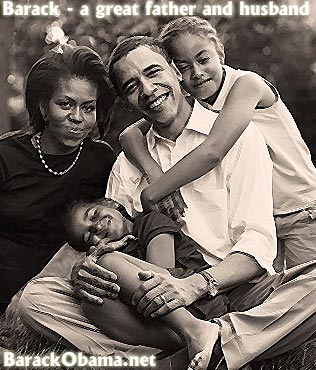
In comparison, Obama has faced incredibly little interrogation in regards to his abilities as a father. His hyper-publicized letter is a prime example of the media's delight with the idea of the president as Father of the Year. While I don't at all doubt that Barack Obama is a genuinely good parent, it seems natural to doubt his ability to be at his daughters' side throughout the next four years, as Sarah Palin was seemingly expected to do. Moreover, Palin was only running for the office of vice president, while Obama has been elected to the office of commander-in-chief itself. With an even busier agenda than Palin, Obama's comparatively celebrated parenting makes it clear that there are still some serious double standards at play in presidential politics. 

It was just Martin Luther King Jr Day: Let's discuss race in the election.


Even though our seminar is technically about gender in the presidential election, I think the issue of race is just as important to bring to the table. I found a great article by Michael A. Fletcher online at Washingtonpost.com regarding Obama being African American. It states that Obama did not call attention to the issue of race for most of his campaign, but that now that he is the President, he can talk more about how his racial identity can bring the country together. In speaking with The Washington Post about the fact that he, as an African American, is going to be President of the United States, Obama said, "I mean, that's a radical thing. It changes how black children look at themselves. It also chances how white children look at black children. And I wouldn't underestimate the force of that."

As a white person I could not be happier that we finally have a black President, and it is so difficult to imagine those who are resentful of this accomplishment. That sad fact goes to show that we have much more growing to do as a country before everyone will be able to look at others in the same way. Unfortunately we will not see that day for a long time, but I have hope that we'll get there eventually. This election will be one that we tell our future children and grandchildren about, and if this was just the spark of a wave of political diversity, then there will be many more elections like this to come. In Obama's inauguration speech he did bring up race, and I thought that to be very important. Though we don't want to think he was elected because of his color, it is still such an accomplishment to those who have endured discrimination in this country over the years and I think he truly reached out to those people with that part of his speech.

In the article I mentioned earlier, however, it stated that the fact that Obama is half-black raises questions as to whether he is "black enough." This is so racist in itself, and just because Obama's mother and grandparents (in the picture above) are white does mean this isn't still an accomplishment for the African American race, something in which they should have pride. After this point, the article began touching on the thought that since Obama is half-black, he is a "good compromise person;" he can feel and relate to the dilemmas of more than one race. I think this to be a strange assumption because anyone can be a "good compromise person," no matter his or her race.

This article is interesting to me because it is discussing the different racial issues that have come up regarding Obama and I would never have thought of them this way. I know that race is significant, but I do not think that it determines one's character or ability to run the country. The fact that people are seriously discussing that issue goes to show it will take some time for this country to reach complete satisfaction with equality. Michael Strautmanis, who has worked with Obama on his Senate staff and will be one of his White House aides, thinks and comments that Obama "just looks at people who would be divided by race and naturally sees what they have in common." He says that Obama "is so comfortable in his own skin that he makes you comfortable in your skin, so you stop thinking about the things that would divide you." This quote really stuck out to me, and I believe this is exactly what he need in a President. I am so thrilled for the era of Obama and I am hopeful for our country in the years to come.

Friday, January 16, 2009

Barack Obama as unisex?

Download Frank Rudy Cooper's article, forthcoming in the Denver Law Review, here.

The abstract follows:
People often talk about the significance of Barack Obama's status as our first black President. During the 2008 Presidential campaign, however, a newspaper columnist declared, "If Bill Clinton was once considered America's first black president, Obama may one day be viewed as our first woman president." That statement epitomized a large media discourse on Obama's femininity. In this essay, I thus ask how Obama will influence people's understandings of the implications of both race and gender.

To do so, I explicate and apply insights from the fields of identity performance theory, critical race theory, and masculinities studies. With respect to race, the essay confirms my prior theory of "bipolar black masculinity." That is, the media tends to represent black men as either the completely threatening and race-affirming Bad Black Man or the completely comforting and assimilationist Good Black Man. For Obama, this meant he had to avoid the stereotype of the angry black man. Meanwhile, though, the association of the Presidency with the hegemonic form of masculinity presented difficulties for Obama. He was regularly called upon to be more aggressive in responding to attacks and more masculine in general. As a result, Obama could not be too masculine because that would have triggered the Bad Black Man stereotype but he could not be too feminine because that would have looked unpresidential.

Obama solved that dilemma by adopting a "unisex" style. He was a candidate who was designed to be suitable to either gender. I believe Obama's unisex performance on the world's biggest stage suggests that we are all more free to perform our race and our gender as we see fit than we had previously believed.

Saturday, November 22, 2008

Barack Obama as parent: Obsession with the Obama girls and a family's personal transition

We've just learned that the Obama girls, Malia (10) and Sasha (7), will attend Sidwell Friends School when they move to Washington, DC, and take up residence in the White House in the coming weeks. Read the story here. This news came after what I found to be a nauseating amount of news attention to the fact that all of the prestigious DC schools were courting the Obama girls. See Rachel Swarns story from the NYT Style pages here. Indeed, interest in Michelle, the girls, and -- of course--the rock star himself, seems to be reaching a fever pitch, which is understandable, I suppose.

I feel sorry for their loss of privacy as they make this transition and we know that their lives will never again be the same. A recent NYT story by Peter Baker takes up this topic:
Life for the newly chosen president and his family has changed forever. Even the constraints and security of the campaign trail do not compare to the bubble that has enveloped him in the 10 days since his election. Renegade, as the Secret Service calls him, now lives within the strict limits that come with the most powerful office on the planet.
A photo accompanying the story shows the Obama girls getting out of an SUV, backpacks in hand, under the watchful eye of the Secret Service. President-Elect Obama is not pictured, but the caption suggests he is in the SUV and involved in dropping the girls off for school.

You can read another report on the Obama family's transition, by Jodi Kantor, here.

Sasha and Malia are the youngest children since John and Caroline Kennedy to have been raised in the White House. Chelsea Clinton, who also attended Sidwell Friends, was a young teen when Bill Clinton became President in 1992. So, it will be interesting to see how Mr. Obama is depicted as father in the coming weeks and months. I recall one voter during the primary season suggesting that, with young children at home, this was not the time for Obama to be seeking the Presidency. Indeed, with the economy falling apart at home (and abroad!) and two wars ongoing, the man is going to be seriously challenged to find time to stay involved with his children.